


Promising Mobile Internet Devices

At the fringe of the CeBIT fair which came to an end last week, Gigabyte gave visitors some insights into the next generation of mobile devices.
A new class of devices introduced by processor manufacturer Intel, and known as MIDs, or Mobile Internet Devices, aims to close the gap between smart phones and subnotebooks.
Gigabyte had four identical MIDs in the colors black and white on show at the fair, and although developers on-site pointed out that the devices were prototypes, they were fine for a first impression.
The "M528", Gigabyte’s first MID raise around 300 grams. According to the datasheet, the device is equipped with an Intel Menlow running at 800 MHz. A quick glance at the console reveals that the CPU fitted here achieved a speed of 1.33 GHz. The display measures 4.8 inches and also serves as the input device. It is very precise, although difficult to read from the side and suffering from nasty reflections in bright light. A full fledged QWERTY keyboard slides out from under the case. Solid state disks with four to eight GB capacity are used for data storage, and the machine has 512 MB RAM. Communications with the outside world rely on WLAN and an integrated HSDPA module. HSDPA means High Speed Downlink Packet Access and is and ongoing development based on UMTS. The technology gives users the ability to download data at speeds of up to 7.2 Mbs and upload at speeds of up to 1.2 Mbps by mobile wireless networks. The device includes two cameras. The battery has a capacity of 3.06 Ah, although Gigabyte is not saying anything about battery life. We wanted to run "lspci" at the console to find out what else was hiding under the hood, but the kernel returned a message with a whole bunch of unknown devices including the graphics chip, USB controller and audio device.
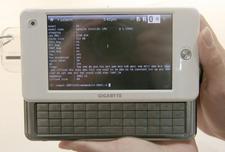
The datasheet specifies an Intel Menlow with a clock speed of 800 MHz, but the console shows that the internal processor is actually running at 1.33 GHz
The operating system installed on the device was Ubuntu 7.10 Gutsy Gibbon with a special interface customized to support the touchscreen. Applications installed included a Web browser, of the software and more on. Users can launch therefore favourite applications by pressing a smart key next to the display. Below the GUI the operating System rounds to customized 2.6.22-14 kernel. The GNU Cross Compiler version 4.2.1 is also included.
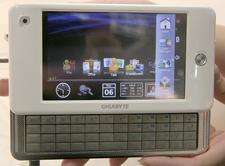
The MID relies on a modified version of Ubuntu.
Our first viewing of the devices and their consoles was really exciting. The MIDs fit snugly into hands and are easy and intuitive to use. Although the manufacturer has not yet completed a full feature set, the devices are very fast. Far lighter than the current crop of tiny subnotebooks, and much bigger and heavier than a smart phone, working with these MIDs is real fun. And if the battery lifetime is far superior to the devices currently on the market, they will be well worth the advertised price of around 500 EUR. Gigabyte has promised Linux Magazine that initial devices will be available at the end of April.
Subscribe to our Linux Newsletters
Find Linux and Open Source Jobs
Subscribe to our ADMIN Newsletters
Support Our Work
Linux Magazine content is made possible with support from readers like you. Please consider contributing when you’ve found an article to be beneficial.

News
-
United Nations Open Source Portal Goes Live
A new open source portal seeks to coordinate and scale open source efforts across the United Nations system.
-
KDE Linux Drops AUR
KDE Linux developers have dropped the Arch User Repository from the build pipeline due to security concerns; other distributions should consider doing the same.
-
California May Exempt Linux from Its Age-Verification Law
After backlash from the Linux community, California may be backing off on its promise to force all operating systems to verify age, but one platform may still have to comply.
-
Another Logic Bug Found in Linux Kernel
Qualys has discovered a vulnerability in the Linux kernel that can be used to elevate standard user privileges.
-
Ubuntu Core 26 Offers Game-Changing Enterprise Features
Ubuntu Core 26 could be a game-changer for organizations looking for increased security and reliability.
-
AI Flooding the Linux Kernel Security Mailing List
AI is giving Linus Torvalds a headache, but not in the way you might think.
-
Top Priorities for Open Source Pros Seeking a New Job
Professional fulfillment tops the list, according to LPI report.
-
Container-Based Fedora Hummingbird Designed for Agent-First Builders
Fedora Hummingbird brings the same approach to the host OS as it does to containers to level up security.
-
Linux kernel Developers Considering a Kill Switch
With the rise of Linux vulnerabilities, the kernel developers are now considering adding a component that could help temporarily mitigate against them… in the form of a kill switch.
-
Fedora 44 Now Gaming Ready
The latest version of Fedora has been released with gaming support.