


Neatly managing and handling PGP/GnuPG keyrings

Key Service

PGP/GnuPG is becoming increasingly popular, thanks to digital crime and government surveillance. We take a look behind the scenes and show how you can keep your keyring current and valid.
If you want to encrypt your data traffic, you first have to gain a general understanding of the concepts and individual steps necessary. Pretty Good Privacy (PGP) or GNU Privacy Guard (GnuPG) let you create key pairs – public and private – and group your keys in keyrings. In this article, I discuss the tools for managing these keyrings and keeping them up to date, including checking them regularly for validity.
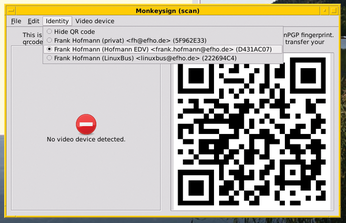
Once you have your key pair, you pass your public key to your communication partners. Traditionally, that either occurs directly as a character string in an email attachment [1], in printed form (e.g., during a key-signing party) [2], or by downloading the key from a web page. For some time, it's been possible to use QR codes that you can receive, check, and manage on your smartphone. In Figure 1, you can see the Monkeysign [3] GUI with the QR code key.
[...]
Buy this article as PDF
(incl. VAT)
Buy Linux Magazine
Subscribe to our Linux Newsletters
Find Linux and Open Source Jobs
Subscribe to our ADMIN Newsletters
Support Our Work
Linux Magazine content is made possible with support from readers like you. Please consider contributing when you’ve found an article to be beneficial.

News
-
Linux Mint 27 Set for a Christmas Release
The developers behind Linux Mint have announced a Christmas release, and it looks like Santa's sack will be brimming with features.
-
Is Linus Torvalds Vibe Coding?
The creator of Linux has added AI into his process for Linux kernel development, and it's more than just for debugging.
-
openKylin 3.0 Released with Expanded AI Integration
The latest release features a pre-installed AI agent to help perform tasks.
-
DigitalOcean Ends Open Source Credits Program
In a change that has surprised many open source developers, DigitalOcean has decided to sunset its Open Source Credits Program.
-
Office 365 Available for Testing on Linux via Bottles
Linux users can now test the official Office 365, thanks to Mirko Brombin's work on Bottles.
-
Dutch Government Turns to Open Source for Digital Sovereignty
Following in the footsteps of other European countries, the Netherlands is looking to increase its sovereign digital infrastructure with open source software.
-
Linux May Soon Work on Snapdragon X2-Based PCs
If you're thinking about buying a Snapdragon X2-based desktop or laptop, Linux may soon be an option.
-
KDE for People Initiative Calls for AI Ban in Plasma
A new community of KDE wants the project to adopt a strict no-AI policy for KDE Plasma.
-
KDE Sets Ambitious Goals for 2026 and Beyond
KDE Connect reveals the goals for the Linux desktop darling, with one of those goals long overdue.
-
It’s Time to Test Fedora 45 Beta
Fedora 45 beta has been released with updated Gnome, KDE Plasma, and kernel.