


An AI module for the Pi 5

Turbocharge Your Raspberry Pi

© Lead Image © Liubomyr Feshchyn, 123RF.com
What happens when the Raspberry Pi's makers and AI specialist Hailo collaborate on a project? We get an official AI kit HAT+ for the Pi 5 that adds an AI accelerator chip.
The Raspberry Pi AI Kit [1] consists of two components: a generic M.2 HAT+, an adaptor board that lets you connect any two M.2 modules (e.g., for NVMe storage) to the Raspberry Pi 5 and therefore directly to the PCI bus, and a Hailo-8L AI accelerator, which could also be installed on any other computer with an M.2 interface. This entry-level AI chip achieves a performance of 13 TOPS, which is half the number of tera-operations per second that you'd get with the standard Hailo-8 model.
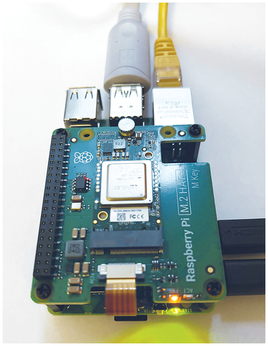
As a first step, you need to assemble the system. Fit the four spacers, a GPIO extension connector, and a PCIe extension cable on the Raspberry Pi. Then slot the M.2 HAT+ onto the spacers and plug the ribbon cable into the connector on the HAT. Figure 1 shows the fully assembled, working system.
[...]
Buy this article as PDF
(incl. VAT)
Buy Linux Magazine
Subscribe to our Linux Newsletters
Find Linux and Open Source Jobs
Subscribe to our ADMIN Newsletters
Support Our Work
Linux Magazine content is made possible with support from readers like you. Please consider contributing when you’ve found an article to be beneficial.

News
-
Is Linus Torvalds Vibe Coding?
The creator of Linux has added AI into his process for Linux kernel development, and it's more than just for debugging.
-
openKylin 3.0 Released with Expanded AI Integration
The latest release features a pre-installed AI agent to help perform tasks.
-
DigitalOcean Ends Open Source Credits Program
In a change that has surprised many open source developers, DigitalOcean has decided to sunset its Open Source Credits Program.
-
Office 365 Available for Testing on Linux via Bottles
Linux users can now test the official Office 365, thanks to Mirko Brombin's work on Bottles.
-
Dutch Government Turns to Open Source for Digital Sovereignty
Following in the footsteps of other European countries, the Netherlands is looking to increase its sovereign digital infrastructure with open source software.
-
Linux May Soon Work on Snapdragon X2-Based PCs
If you're thinking about buying a Snapdragon X2-based desktop or laptop, Linux may soon be an option.
-
KDE for People Initiative Calls for AI Ban in Plasma
A new community of KDE wants the project to adopt a strict no-AI policy for KDE Plasma.
-
KDE Sets Ambitious Goals for 2026 and Beyond
KDE Connect reveals the goals for the Linux desktop darling, with one of those goals long overdue.
-
It’s Time to Test Fedora 45 Beta
Fedora 45 beta has been released with updated Gnome, KDE Plasma, and kernel.
-
Ubuntu Stonking Stingray Gets Even Rustier
Ubuntu 26.10 has completed its migration to the Rust-based coreutils.