


Waiting for LibreOffice Table Styles

Off the Beat: Bruce Byfield's Blog
Like most word processors, LibreOffice Writer includes character and paragraph styles. However, Writer draws much of its power as a mid-level desktop publisher from the addition of frame, list, and page styles. Yet one type is has lacked ever since it was a proprietary application called StarDivision two decades ago is table styles. It is only in 2016's Google Summer of Code (GSOC) that a focused effort is planned to implement table styles at last.
Instead, Writer has what it calls Autoformats. Once a table is added to a document, Tables> Autoformat offers what I call pseudo-styles. By that, I mean that, although Autoformats quickly format a table and can be created by users, they otherwise do not act like styles. Each Autoformat is a collection of manual changes, so that if you want to change the format of two identically formatted tables, you have to do so one table at a time, instead of changing the Autoformat and having the changes automatically update every table that uses the Autoformat. Nor are Autoformats hierarchical, so that changing a parent automatically changes its children. They can't be imported into another document, either.
In fact, Autoformats are physically separate from the true styles, being listed in the Table main menu, and not in the Styles and Formatting window. They are better than doing the manual formatting for each table yourself, but you could achieve much the same convenience by copying and pasting.
These limitations are obvious to anyone who works with tables in LibreOffice. I noticed them in OpenOffice.org around 2001, and I am unlikely to have been the first. However, Sun Microsystems, which owned OpenOffice.org for years, was notoriously conservative about changes in features, let alone structure. Similarly, athough LibreOffice is far more open to change than its predecessor, Sun's conservatism left LibreOffice developers with so much to do that they can hardly be blamed for taking some time to get around to table styles.
Establishing the base camp
According to Jan Holešovský-Kendy, in 2013, GSOC student Alex Ivan worked on implementing table styles, but did not complete the work, or leave it in usable form. Blogging in October 2015, Jan Holešovský-Kendy explained how, starting with Ivan's code, he had worked to make the existing Autoformat behave more like table styes with some success. For example, in recent LibreOffice releases, a new row or column automatically has the Autoformat of its table applied to it, and no longer has to have the Autoformat applied separately -- a small, but welcome improvement.
Work in 2016 will apparently be based on a LibreOffice Design Team blog post in December 15. Noting that Open Document Format, LibreOffice's file format, contains all the necessary tags for implementing table styles, the blog post includes a single dialog window that would almost surely be divided along the lines of existing style, with an Organizer tab, complete with a formatting summary and a preview, and separate panes for Properties that would allow the specification of a particular part of a table, such as Odd Rows, as well as Cells, Border, and Text.
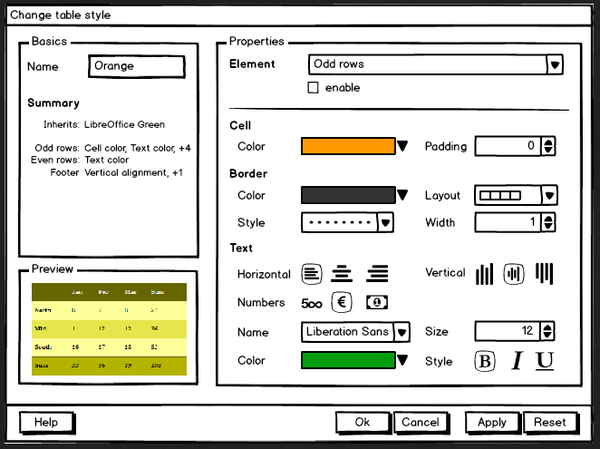
Assuming that Table styles, like other styles, would re-use exist tabs as much as possible, I would assume that far more features would become available than shown in the markup. Probably, too, table styles would become available in the Styles and Formatting window and the Format main menu, and perhaps the Table main menu and right-click menu as well.
Possible Lessons from FrameMaker
Until now, my concept of table styles has been influenced mainly by FrameMaker. FrameMaker is a documentation and text layout tool popular among technical writers. It is frequently criticized for being slow to implement new features, but in expert hands its tools can be more than enough for complex results.
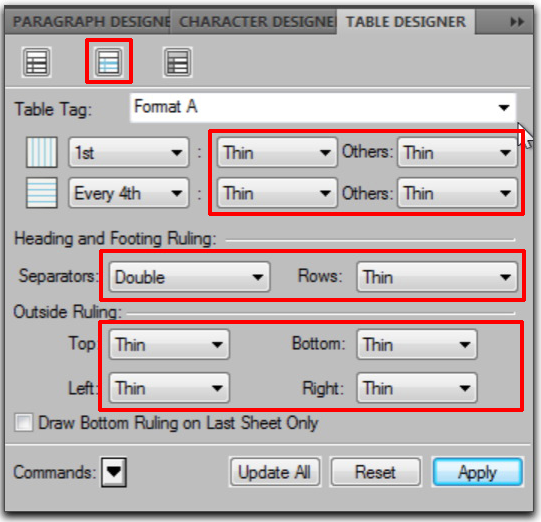
Comparing the LibreOffice proposal to FrameMaker's table styles dialog, I suspect that LibreOffice developers have already borrowed ideas, such as the ability to choose table elements for individual formatting -- although perhaps the similarities are due to the constraints of tables rather than borrowing.
However, I hope that LibreOffice will also consider other aspects of Framemaker's implementation, such as a selection of row and column structures, and the selection of multiple elements to produce formatting patterns, such as adding a particular shade to every second row. Other useful formats might include adding separators to the list of borders, so that rows and columns can be visually grouped together, and a unique border to indicate the bottom of a table.
According to the Design Team blog, work was already advanced in developing the concept of table styles, so this time they might actually happen.
I can only hope so. Tables are a common element in Writer documents, and Autoformats ought to have become extinct years ago.
comments powered by DisqusSubscribe to our Linux Newsletters
Find Linux and Open Source Jobs
Subscribe to our ADMIN Newsletters
Support Our Work
Linux Magazine content is made possible with support from readers like you. Please consider contributing when you’ve found an article to be beneficial.

News
-
Bottlenecks Discovered by Meta Engineers Lead to Scalability Improvements
Thanks to a small group of engineers at Meta, the Linux kernel module kernfs has been improved, which has led to some serious gains.
-
PwnEscape Poses VM Vulnerability
A guest-to-host escape flaw in Linux KVM, named PwnEscape, might be yet another means of attacking Linux.
-
Linux Mint 27 Set for a Christmas Release
The developers behind Linux Mint have announced a Christmas release, and it looks like Santa's sack will be brimming with features.
-
Is Linus Torvalds Vibe Coding?
The creator of Linux has added AI into his process for Linux kernel development, and it's more than just for debugging.
-
openKylin 3.0 Released with Expanded AI Integration
The latest release features a pre-installed AI agent to help perform tasks.
-
DigitalOcean Ends Open Source Credits Program
In a change that has surprised many open source developers, DigitalOcean has decided to sunset its Open Source Credits Program.
-
Office 365 Available for Testing on Linux via Bottles
Linux users can now test the official Office 365, thanks to Mirko Brombin's work on Bottles.
-
Dutch Government Turns to Open Source for Digital Sovereignty
Following in the footsteps of other European countries, the Netherlands is looking to increase its sovereign digital infrastructure with open source software.
-
Linux May Soon Work on Snapdragon X2-Based PCs
If you're thinking about buying a Snapdragon X2-based desktop or laptop, Linux may soon be an option.
-
KDE for People Initiative Calls for AI Ban in Plasma
A new community of KDE wants the project to adopt a strict no-AI policy for KDE Plasma.