Teaching a Rasp Pi Model B to Speak

Voice from the Edge

© Lead Image © Nastya Bobko, 123RF.com
bitVox, a small voice assistant built on a 2011 Raspberry Pi Model B, separates hardware control, speech processing, intent routing, and skills into plain Linux processes, allowing you to read, test, and modify one piece at a time.
Most voice assistant projects start with a comfortable assumption: the hardware will be fast enough, the SDK will hide the messy parts, and the cloud will do the heavy lifting. bitVox started from the opposite direction: I wanted to find out how far I could go with a Raspberry Pi Model B from 2011 (which is a single-core ARMv6 at 700MHz with 512MB RAM) and a design rule that every important step had to remain visible and testable from the terminal.
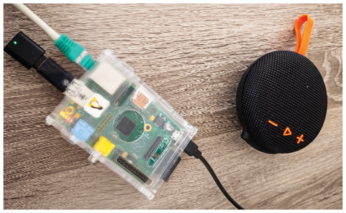
The result is neither a commercial assistant nor a benchmark machine. Instead, bitVox is an educational, local-first experiment (Figure 1). It uses Python for hardware and audio I/O, PHP for routing and skills, simple Linux IPC for process coordination, and external cloud services only where the Rasp Pi would obviously lose the fight: speech recognition, language generation, and text-to-speech (TTS). The full source is on GitHub [1].
[...]
Buy this article as PDF
(incl. VAT)