


LinuxTag 2009: Resource Management with OpenVZ

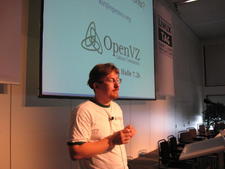
OpenVZ project leader Kir Kolyshkin clarified at LinuxTag 2009 that the software also lends itself to Linux resource management.
The facts are clear, Koyshkin said at the outset: every computer has but finite resources such as CPU time, memory, hard disk size and I/O, and network I/O. Administrators are interested in protecting these resources from DoS attacks so that they can continue providing QoS or simple processing.
The Linux kernel already provides resource management tools, said Kolyshkin: disk quotas, nice and renice, the real-time priority queue and limits on CPU time with ulimit -c. Ulimit alone controls 16 different parameters. However, Kolyshkin doesn't find this pallet to be enough. Some limits can't be set and the others are done so at login and can't subsequently be regulated. This is where Kolyshkin brought OpenVZ into the picture. The software allows creating multiple isolated userspace instances, called containers, on a single kernel. Webhosters, for example, could use these containers for their services. From a resource management viewpoint, containers are simply groups of processes.
OpenVZ brings its own resource control mechanisms, called beancounters, that have access to 20 parameters modifiable for process groups at runtime. These groups can be containers, users or applications. For example, the Apache 2 webserver has many processes that could more sensibly combined into application groups. OpenVZ categorizes these user beancounters (UBCs) on its wiki page.
Kolyshkin revealed that further mainline kernel control mechanisms are available through control groups (cgroups) developed over the years by the big iron folks at Bull and SGI. Paul Menage was responsible for bringing cgroups into the Linux kernel for grouping processes for binding memory controllers. Cgroups, however, don't offer as many features as OpenVZ's beancounters, although Kolyshkin wishes for future OpenVZ features such as shared pages accounting, I/O priorities per cgroup and checkpoint/recreate. The latter freezes the state of a group and is used by container or virtualization software such as OpenVZ and Xen for live migration. Further details are in the /usr/src/linux/Documentation/cgroups/* and /controllers/* directories of the kernel source code.
Kolyshkin would love to see the OpenVZ container features integrated into the mainline kernel, but that will "take years." But he's thinking of the future: integration of checkpoint/recreate in the official Linux kernel.
Subscribe to our Linux Newsletters
Find Linux and Open Source Jobs
Subscribe to our ADMIN Newsletters
Support Our Work
Linux Magazine content is made possible with support from readers like you. Please consider contributing when you’ve found an article to be beneficial.

News
-
Office 365 Available for Testing on Linux via Bottles
Linux users can now test the official Office 365, thanks to Mirko Brombin's work on Bottles.
-
Dutch Government Turns to Open Source for Digital Sovereignty
Following in the footsteps of other European countries, the Netherlands is looking to increase its sovereign digital infrastructure with open source software.
-
Linux May Soon Work on Snapdragon X2-Based PCs
If you're thinking about buying a Snapdragon X2-based desktop or laptop, Linux may soon be an option.
-
KDE for People Initiative Calls for AI Ban in Plasma
A new community of KDE wants the project to adopt a strict no-AI policy for KDE Plasma.
-
KDE Sets Ambitious Goals for 2026 and Beyond
KDE Connect reveals the goals for the Linux desktop darling, with one of those goals long overdue.
-
It’s Time to Test Fedora 45 Beta
Fedora 45 beta has been released with updated Gnome, KDE Plasma, and kernel.
-
Ubuntu Stonking Stingray Gets Even Rustier
Ubuntu 26.10 has completed its migration to the Rust-based coreutils.
-
AI Fixes Linux Bottlenecks Using “Hideous” Code
A Linux developer used AI to fix bottlenecks that caused problems when building the kernel. The resulting AI-generated code needed a lot of work.
-
Advanced Video Coding Still Under Patent
Brazilian patent BRPI0109962B1 has expired, which means that DivX and Xvid are no longer problematic for Linux, but it doesn’t mean that video is all of a sudden fully unleashed.
-
2,000 Vulnerabilities per Linux Release
Thanks to AI bug hunters, the Linux kernel is seeing record numbers of vulnerabilities, and it's overwhelming developers.