


Open Source World Map

In association with the Georgia Institute of Technology, Red Hat has carried out an open source index study and published it in the form of a world map.
The study ascertains the level of open source development in over 75 countries and measures the potential for the spread of free software in each land. Red Hat has given the project the name Open Source Index. More information about the study is available here as PDF and raw data can be downloaded from the Red Hat homepage. The study is available under the Creative Commons Attribution Share Alike License 3.0 (CC By SA). On its homepage, Red Hat encourages viewers of the study to come to their own conclusions.
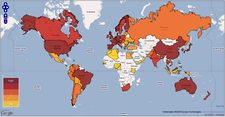
From the gathered data, Red Hat has created two world maps. The Activity Map shows the level of actual active open source development present in each country, calculating an average value from the three areas of study, community, industry and government. France leads with first place in the government and third place in the community categories, with Spain and Germany closely following. The number one position in the community category was taken by Estland, followed by North America.
The Environment Map displays the amount of open source potential found in each country. Evaluating factors were among others; Internet penetration and the availability of technologies (patents). According to the study, Sweden has the greatest potential for open source development, followed by the USA, Norway and then Denmark.
Subscribe to our Linux Newsletters
Find Linux and Open Source Jobs
Subscribe to our ADMIN Newsletters
Support Our Work
Linux Magazine content is made possible with support from readers like you. Please consider contributing when you’ve found an article to be beneficial.

News
-
Is Linus Torvalds Vibe Coding?
The creator of Linux has added AI into his process for Linux kernel development, and it's more than just for debugging.
-
openKylin 3.0 Released with Expanded AI Integration
The latest release features a pre-installed AI agent to help perform tasks.
-
DigitalOcean Ends Open Source Credits Program
In a change that has surprised many open source developers, DigitalOcean has decided to sunset its Open Source Credits Program.
-
Office 365 Available for Testing on Linux via Bottles
Linux users can now test the official Office 365, thanks to Mirko Brombin's work on Bottles.
-
Dutch Government Turns to Open Source for Digital Sovereignty
Following in the footsteps of other European countries, the Netherlands is looking to increase its sovereign digital infrastructure with open source software.
-
Linux May Soon Work on Snapdragon X2-Based PCs
If you're thinking about buying a Snapdragon X2-based desktop or laptop, Linux may soon be an option.
-
KDE for People Initiative Calls for AI Ban in Plasma
A new community of KDE wants the project to adopt a strict no-AI policy for KDE Plasma.
-
KDE Sets Ambitious Goals for 2026 and Beyond
KDE Connect reveals the goals for the Linux desktop darling, with one of those goals long overdue.
-
It’s Time to Test Fedora 45 Beta
Fedora 45 beta has been released with updated Gnome, KDE Plasma, and kernel.
-
Ubuntu Stonking Stingray Gets Even Rustier
Ubuntu 26.10 has completed its migration to the Rust-based coreutils.