


Managing Debian packages with deborphan

Command Line – deborphan

© Lead Image © Ka Ho Leung, 123RF.com
The deborphan utility helps you keep track of packages and their dependencies on a Debian-based system.
Debian is distinguished by its utilities for package management. Every package manager has command options, but Debian also has at least 87 utility packages for everything from creating a package to managing installed packages. Some of these utilities, such as apt-cache, have been added to apt (the stripped down version of apt-get), while Nala uses fetch to find the fastest mirror like netselect-apt does. While many of the other available utilities remain hidden in the Debian repositories, they are worth seeking out. A prime example is deborphan [1], which identifies unneeded packages. This ability is useful for freeing up space on a system and, equally importantly, for knowing exactly what is installed, which is a prerequisite for security.
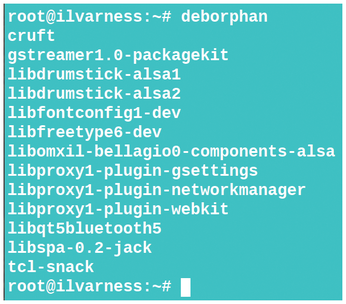
The deborphan utility takes its name from Debian's name for packages that are not dependent on any other packages. These orphans are the remnants of packages that have been deleted and left behind because Debian's package management commands do not remove dependencies, regardless of whether a package is removed or purged. Orphans can be formerly required packages, recommended packages that add enhancements most users would want, and suggested packages that add enhancements that some users may want. If you are constantly exploring and deleting packages, orphans can quickly multiply, especially because recommended and suggested packages can sometimes outnumber the required dependencies. Wrappers (i.e., packages such as apt that provide a common interface for related packages) are especially likely to have numerous dependencies. Left unchecked, orphans can waste memory and greatly increase potential security vulnerabilities. By default, deborphan detects orphans by searching /libs and /oldlibs to detect unused libraries (Figure 1), although its search can be expanded. It records the status of available packages in /var/lib/dpkg/status and packages to keep in no particular order in /var/lib/deborphan/keep.
[...]
Buy this article as PDF
(incl. VAT)
Buy Linux Magazine
Subscribe to our Linux Newsletters
Find Linux and Open Source Jobs
Subscribe to our ADMIN Newsletters
Support Our Work
Linux Magazine content is made possible with support from readers like you. Please consider contributing when you’ve found an article to be beneficial.

News
-
Pine64 Halts Production of Linux Devices
With continued DRAM and eMMC shortages, Pine64 has decided to discontinue production of Linux devices.
-
The Bullet-Proof KDE Software Initiative Is Coming
KDE, Techpaladin, and Kubuntu Focus have announced a new initiative that will provide at least three years of support for KDE Plasma 6.6 LTS and related software.
-
Linux Mint Shares a Possible Kernel Cleanup Solution
For those on Linux Mint who like to keep multiple kernels around but don't want them to take up too much space, you might be getting a new automated tool.
-
CachyOS Gets an Update
CachyOS August 2026 release is now available with the latest version of KDE, some new features, and plenty of improvements.
-
The Linux Kernel Dev Staging Area Now Rejects AI-Generated Patches
Unless a kernel patch is a valid security fix, it will be rejected if it was created using AI.
-
Linux Surpasses Double-Digit Market Share
According to two sources, the Linux operating system has hit a major milestone in market share that naysayers thought would never happen.
-
AI Helped Develop a Linux Exploit
A use-after-free race exploit was discovered and exploited on CentOS Stream 9.
-
Yet Another Linux Kernel Vulnerability Discovered
Affecting millions of systems, a kernel flaw discovered by Qualys could allow users to gain root privileges.
-
Ubuntu 26.10 to Include Ubuntu Certified Hardware Check
If you've ever wondered if your laptop or PC is officially certified to run Ubuntu, that curiosity will soon be met.
-
Substantial Update to IPFire Now Available
The lastest version of IPFire features a fundamental change to how the system handles DNS.