


Is the Ghost CMS Ready to Replace WordPress?
Ghost API and Zapier Integrations
Ghost provides a powerful open source API [15] that allows third-party websites and applications to interact with Ghost websites. Ghost also officially supports Zapier [16], a popular service for automating AI workflows, apps, and agents. Zapier connects Ghost with other services, like Stripe, Slack, ChatGPT, Facebook Pages, PayPal, and even WordPress! Some examples of possible Ghost interactions include:
- Sending welcome emails to new members using email
- Sharing new posts from Ghost to Facebook Pages
- Posting Discord channel messages when new posts are published in Ghost
- Sending new drafts from Google Docs to Ghost
- Creating LinkedIn share updates for new published posts in Ghost
You will no doubt think of other possibilities when you bring Zapier and the Ghost API to your own web context.
Newsletters and Mailgun
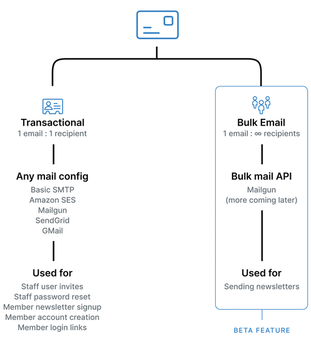
Ghost users are forced to use Mailgun for bulk email newsletters [17], and this is a really weird part of Ghost usability. Figure 9 shows how Ghost works with email. The problem is, Mailgun is a third-party, proprietary service, and it is the one and only service that Ghost supports for bulk email. That doesn't seem like a fair choice, and it is close to a form of vendor lock-in. Why not use a general email service with SMTP protocol support? "Sending a bulk email to many recipients … will result in your IP address being instantly blacklisted and marked as spam by all mail providers" says the Ghost documentation. That's partially correct, but why not give the user chance to choose? Also, will a general mail service really ban accounts for sending a message to 5 or 10 addresses? I have high doubts about that. There are two ways to use Ghost without Mailgun: by using Zapier integrations with other mail services or by building custom mail lists, independently of Ghost. Unfortunately, both of these options detract from the efficiency and ease-of-use offered by Ghost.
Conclusion
Ghost is the perfect solution for blogging and related areas, such as podcasting, portfolios, and news. Although WordPress is more powerful with many more add-ons and themes, it definitely loses in the simplicity of its interface. Creating a new post in Ghost is easy, even for beginners, and all of the complex functionality is well-documented.
Is Ghost ready to replace WordPress? Yes, absolutely, in its specific niche. However, if you expect to add 100 or more add-ons to transform Ghost into a powerful corporate website, it's not going to work very well. You can customize Ghost, but it is not a construction kit like WordPress and was never designed to be.
Final words to the potential Ghost audience: Many great stories have never been told, and many outstanding creative projects have never been created simply because their creators weren't sure how to get started with realizing their ideas. If you have an idea for something you'd like to do on the web, give it a shot, and let Ghost be a faithful companion on your journey.
Infos
- WordPress: https://wordpress.org/
- Automattic: https://automattic.com/2025/01/09/aligning-automattics-sponsored-contributions-to-wordpress/
- Ghost: https://ghost.org/
- Koenig: https://github.com/TryGhost/Koenig
- Ghost CLI: https://github.com/TryGhost/Ghost-CLI
- GCTools: https://github.com/TryGhost/gctools
- Ghost installs: https://ghost.org/about/
- Earnings of Ghost publishers: https://ghost.org/changelog/6/
- Docker Installation Guide: https://docs.docker.com/engine/install/
- Tinybird analytics: https://www.tinybird.co/
- Ghost routing: https://docs.ghost.org/themes/routing
- Ghost Themes Marketplace: https://ghost.org/themes/
- Handlebars: https://handlebarsjs.com/
- ActivityPub promo: https://activitypub.ghost.org/
- Ghost API: https://docs.ghost.org/admin-api
- Zapier: https://zapier.com/
- Mailgun newsletters: https://docs.ghost.org/faq/mailgun-newsletters
The Author

Paul Nixer has been a Linux user and FOSS advocate since the late 2000s. He is passionate about privacy, security, networks, and community-driven development. Find Paul on Mastodon at: https://mastodon.social/@paulnixer.
« Previous 1 2 3
Buy this article as PDF
(incl. VAT)
Buy Linux Magazine
Subscribe to our Linux Newsletters
Find Linux and Open Source Jobs
Subscribe to our ADMIN Newsletters
Support Our Work
Linux Magazine content is made possible with support from readers like you. Please consider contributing when you’ve found an article to be beneficial.

News
-
System76 Announces the New Thelio Prime Desktop
The makers of the Thelio desktop line and Pop!_OS have released a powerful small form factor PC.
-
A Must See KDE Documentary
It doesn't matter what desktop environment you prefer, this KDE documentary should top your list of things to watch.
-
New KORA Linux Distro to Harness the Power of Local AI
The development team behind CyanogenMod, Android, and Playtron unveils KORA, a Linux distribution built specifically for AI nerds.
-
Epic Games Targets Linux for New Launcher
The Epic Games new launcher is still in preview, but it looks to land on several Linux distributions.
-
Fedora 45 Now Available
The latest iteration of Fedora has arrived with Gnome 51 and KDE Plasma 6.8.
-
Linux 7.4 is "Much Healthier" Thanks to AI
At nearly 42 million lines, Linux 7.4 is the largest merge in the kernel’s history.
-
Working Exploit for a Linux Kernel Flaw Made Public
Even before a bug received its CVE identifier or an upstream fix, the local privilege escalation vulnerability exploit found its way into the wild.
-
r/opensource Bans AI-Assisted and AI-Related Projects
The de facto subreddit for all things open source has not only banned AI-related projects but also users who "don't speak English."
-
Bottlenecks Discovered by Meta Engineers Lead to Scalability Improvements
Thanks to a small group of engineers at Meta, the Linux kernel module kernfs has been improved, which has led to some serious gains.
-
PwnEscape Poses VM Vulnerability
A guest-to-host escape flaw in Linux KVM, named PwnEscape, might be yet another means of attacking Linux.