


A tale of a serial cable

Beagleblog
Finally the BeagleBoard has arrived. Unfortunately custom offices are charging me additional US$ 30. Ripping the package open I am shocked: It's so tiny! On first sight I can't find the OMAP processor. Almost by chance I find the explanation reading through some web site. Following the PoP construction principle (Package on a Package) the memory chip is mounted on the CPU.
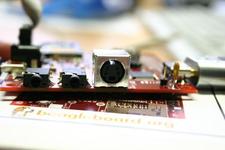
A yellow LED shows that the power supply via the USB port is working. For connecting the BeagleBoard with a PC you need an AT/Everex serial cable, which plugs into the pin header of the board and has a RS-232 serial port on the other end. You might have a hard time getting one of these at your local dealer because stuff like this is considered "legacy" these days. So better order one together with your board.
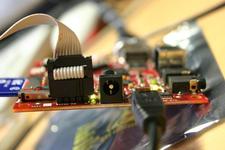
Unfortunately the cable I found at some old-school dealer seems to have a different pinout than required. It just doesn't work whatever pinout or settings in the terminal program Minicom I try (it's 115200,8N1, no flow control for those who know). Luckily my workmate has recycled one that works from an old PC. So upon plugging in the BeagleBoard the TI boot loader appears:
Texas Instruments X-Loader 1.41
Starting OS Bootloader...
U-Boot 1.3.3 (Jul 10 2008 - 16:33:09)
OMAP3530-GP rev 2, CPU-OPP2 L3-165MHz
OMAP3 Beagle Board + LPDDR/NAND
DRAM: 128 MB
NAND: 256 MiB
In: serial
Out: serial
Err: serial
Audio Tone on Speakers ... complete
OMAP3 beagleboard.org #
That's US$4.50 down the drain for that alleged Everx cable, but whatever, it's working now. Next step will be to install an actual Linux distribution on the small computer.
Comments
comments powered by DisqusSubscribe to our Linux Newsletters
Find Linux and Open Source Jobs
Subscribe to our ADMIN Newsletters
Support Our Work
Linux Magazine content is made possible with support from readers like you. Please consider contributing when you’ve found an article to be beneficial.

News
-
openKylin 3.0 Released with Expanded AI Integration
The latest release features a pre-installed AI agent to help perform tasks.
-
DigitalOcean Ends Open Source Credits Program
In a change that has surprised many open source developers, DigitalOcean has decided to sunset its Open Source Credits Program.
-
Office 365 Available for Testing on Linux via Bottles
Linux users can now test the official Office 365, thanks to Mirko Brombin's work on Bottles.
-
Dutch Government Turns to Open Source for Digital Sovereignty
Following in the footsteps of other European countries, the Netherlands is looking to increase its sovereign digital infrastructure with open source software.
-
Linux May Soon Work on Snapdragon X2-Based PCs
If you're thinking about buying a Snapdragon X2-based desktop or laptop, Linux may soon be an option.
-
KDE for People Initiative Calls for AI Ban in Plasma
A new community of KDE wants the project to adopt a strict no-AI policy for KDE Plasma.
-
KDE Sets Ambitious Goals for 2026 and Beyond
KDE Connect reveals the goals for the Linux desktop darling, with one of those goals long overdue.
-
It’s Time to Test Fedora 45 Beta
Fedora 45 beta has been released with updated Gnome, KDE Plasma, and kernel.
-
Ubuntu Stonking Stingray Gets Even Rustier
Ubuntu 26.10 has completed its migration to the Rust-based coreutils.
-
AI Fixes Linux Bottlenecks Using “Hideous” Code
A Linux developer used AI to fix bottlenecks that caused problems when building the kernel. The resulting AI-generated code needed a lot of work.
Good tip on the details
Mike
Thanks
Best
Oliver
Everex cables
http://jefro.wordpress.com/...eagle-board-development-parts/
but there are many better ones, particularly on Meld (http://meld.mvista.com) and elinux.org (http://elinux.org).
Have fun!