


LinuxTag 2009: GUIs of the Future with QML

In his keynote at the LinuxTag 2009 in Berlin, KDE founder Matthias Ettrich spoke about the future of user interfaces on mobile devices. In the process he presented QML, the newest development from his employer Qt Software.
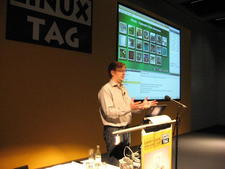
Ettrich's talk was titled "New user interface paradigms on mobile devices" and addressed GUI developers. He began with a bit of history: ten years ago programming was at the forefront of development, with UIs "quickly assembled in about two hours." That has since change. Users now demand much more sophisticated UIs, and make purchasing decisions based on them.
The whole paradigm of GUI development has thus shifted. Graphics processing is faster, resolutions better and mobile devices provide new input mechanisms. These conditions, according to Ettrich, require diverging from the traditional development model. No more boxed, rectangular widgets. These components are much too difficult to turn on and off, scale or otherwise change, and don't allow consistent backgrounds.
"The boundaries should no longer be set only by technology but by the creativity of the developer," offered Ettrich. As a tool that represents this new style of thinking he presented QML, a declarative UI language from Qt Software's development lab in Brisbane, Australia. QML is an extension of the existing Qt Toolkit and is under LGPL licensing.
Ettrich showed some sample applications that he created onstage using Qt Creator to showcase the new QML language. He demonstrated the properties, states and transitions that are typical for QML.
A Qt Labs blog presents a video of QML in action and some sample code. It also includes links to the Windows binaries and Gitorious source code repository.
Subscribe to our Linux Newsletters
Find Linux and Open Source Jobs
Subscribe to our ADMIN Newsletters
Support Our Work
Linux Magazine content is made possible with support from readers like you. Please consider contributing when you’ve found an article to be beneficial.

News
-
openKylin 3.0 Released with Expanded AI Integration
The latest release features a pre-installed AI agent to help perform tasks.
-
DigitalOcean Ends Open Source Credits Program
In a change that has surprised many open source developers, DigitalOcean has decided to sunset its Open Source Credits Program.
-
Office 365 Available for Testing on Linux via Bottles
Linux users can now test the official Office 365, thanks to Mirko Brombin's work on Bottles.
-
Dutch Government Turns to Open Source for Digital Sovereignty
Following in the footsteps of other European countries, the Netherlands is looking to increase its sovereign digital infrastructure with open source software.
-
Linux May Soon Work on Snapdragon X2-Based PCs
If you're thinking about buying a Snapdragon X2-based desktop or laptop, Linux may soon be an option.
-
KDE for People Initiative Calls for AI Ban in Plasma
A new community of KDE wants the project to adopt a strict no-AI policy for KDE Plasma.
-
KDE Sets Ambitious Goals for 2026 and Beyond
KDE Connect reveals the goals for the Linux desktop darling, with one of those goals long overdue.
-
It’s Time to Test Fedora 45 Beta
Fedora 45 beta has been released with updated Gnome, KDE Plasma, and kernel.
-
Ubuntu Stonking Stingray Gets Even Rustier
Ubuntu 26.10 has completed its migration to the Rust-based coreutils.
-
AI Fixes Linux Bottlenecks Using “Hideous” Code
A Linux developer used AI to fix bottlenecks that caused problems when building the kernel. The resulting AI-generated code needed a lot of work.