Trusted name resolution with DNSSEC
Chains of Trust
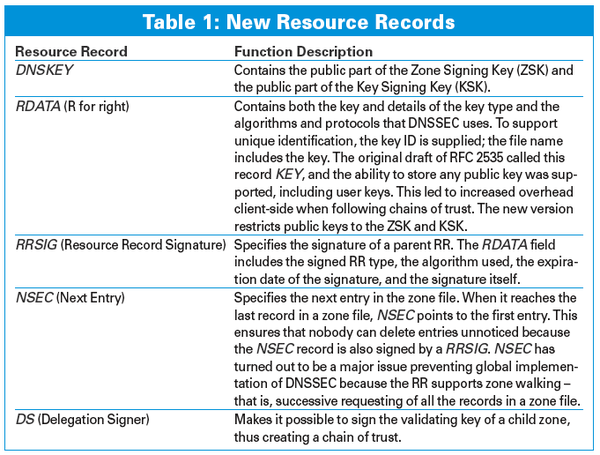
DNSSEC uses asymmetric key pairs – that is, pairs of private keys and public keys. The two-element system was devised by IETF (Internet Engineering Task Force) architects. A Zone Signing Key (ZSK) protects the individual RRs in a zone file and, in turn, is protected by the Key Signing Key (KSK) (see Figure 2).
Inside a zone, it is sufficient to know the public KSK to validate the ZSK and then the RRs. Between a parent and a child zone, DNSSEC uses a delegation signer RR (DS-RR). At the top of the chain of trust is a KSK, which specifies the SEP, or Trusted Anchor, and designates the zone hierarchy below it as a secure island. Adding these SEPs to the DNSSEC server configuration is the responsibility of an organization's admin.
To do so, the admin enters the KSKs for the secure islands to be supported to the trusted-keys section of the named.conf file (see Listing 1). The hierarchy should use the highest possible KSKs available and make sure that the keys were transferred in a trustworthy manner. The zone names are followed by three fields. The Flags field defines the key type; 256 stands for ZSK and 257 for KSK. The second value is the Protocol field, which must contain a 3, in line with RFC 4034. The third value specifies the algorithm used, with 5 standing for RSA/SHA-1.
Listing 1
DNS Config for SEPs
01 trusted-keys {
02 "example.com." 257 3 5
03 "AwEAAcDKu5Kqbk92caGeQ2GjQDucJ2t6jfUb
04 gdye+zyw6qS9PorViM5ViTifFt1JYgB5RnGf
05 wFwqEDm2eeopakOYnJdnVAgDJFd/4sEp7dJW
06 A4zPEvy8LYXCAqkbL5FqZcv9fbYHF2rKYlZJ
07 y5MbmEOk/X4nrxcjwSIcbpIe4/mhjWmR1+jA
08 AVlyODwko2edeilKuW5y/LpPvdZ3qXsw6mTU
09 pa39NcGbzDbHVyFZrQhnxjCD2cy6rWe5ZYck
10 c9VyQQafFLXx5h56Aif0mi1i7f7uZjm6wAIc
11 iv+CkVUfKbcdqpoBThBWH67VqD8kljLRsEGt
12 wRWZbGfjhuGkm56MHZCfYTk=";
13
14 "tux.local." 257 3 5
15 "AwEAAa+z+JB9qd6Q9Kg7isg/DqJdqX9Kqxpu
16 One4zGlUWNJXAT5ivVva5N4l1YOPfq2M+dJH
17 Mxg9jmFZmrTLS8HYvuYzTVuBMh1u3hvS6UBr
18 SzEJdqWDpO/AJbWDUP+SIfryeW0ZV7weHDX7
19 Xjqrrh2+8+Dc/k8LFxoocBeio9gljYMLdIvM
20 ddOUOhFxx6o4WvVNhuWF+i1HDoqGDOOWgRCk
21 9KO0fZpx8h/dwwyqL4/9Zk0MLF6KQaxg0+tQ
22 khhI6sq+7BYmnNBauJQlwLY8qrlA/gaajahU
23 PaHbJ1vzg+G5mLFI1vEt5FTGVXWJp0GWD6yK
24 uLdrYlL0oOapQ8FG9AqMrvk=";
25 };
Client or Server?
The standard scenario uses a DNS server as the resolver on the local network that queries a forwarder on the provider's network. The DNS server validates the responses it receives from the provider-side DNS server. To be able to do so, the administrator first must enable DNSSEC. As of version 9.4.2, ISC recommends a BIND server. Enabling DNSSEC when building the program is imperative. Most distributions offer this option as part of their bind9 packages. The dnssec-tools are useful for testing and debugging but are not necessary to run the system [4].
The dnssec-enable yes; option in the named.conf configuration file generically enables DNSSEC functionality. If at least one trusted key is defined as a SEP, you just need to reload named; the resolver in this example would validate the example.com and tux.local zones, as well as any zones below them in the chain of trust (e.g., branch1.example.com).
Signing a Zone
Name server operators first must generate and set up key pairs for their domains and zones, starting with ZSKs and KSKs on the primary domain server to sign the individual zone records. Authoritative zone servers must be enabled by setting dnssec-enable yes; for DNSSEC. The following command issued on the primary name server creates a key pair for the example.com zone:
dnssec-keygen -a RSASHA1 -b 2048 -n ZONE example.com
The -a option specifies the algorithms RSA and SHA1. Although the developers typically recommend RSA with SHA-1, you can specify other algorithms, such as DSA or RSA/MD5.
The -b parameter specifies the key length, and -n is followed by the record owner, which is ZONE for a zone; however I will ignore other records (i.e., HOST, ENTITY, USER) for the purposes of this article.
The newly created key serves as the ZSK. To create a matching KSK, you need to add the -f KSK option to the command. This results in a file called Kexample.net.+005+18553, which is a concatenation of K for the KSK, the domain name, the encryption and hash algorithms, and a randomly generated key ID separated by plus characters. The algorithm designators are 1 for RSA/MD5, 3 for DSA, and 5 for RSA/SHA-1.
After generating the keys, listing the current directory should reveal the public key with its .key file extension and the private key with a suffix of .private. Now the public key (see Listing 2) can be added to the zone file with the $include directive, as shown in Listing 3.
Listing 2
Key Entry for a Zone File
01 cat Kexample.net.+005+18553.key 02 example.net. IN DNSKEY 256 3 5 ( 03 ZUPI4+0M1V0+SQmFzHQtZMuzLH3UxWE0GmG5Gfj... 04 ijandHGG8lD3IO1azWN6DiVFEVzgr0otAdDonfY... 05 =oElkw== )
Listing 3
Zone File Before Signing
01 ; example.com zone 02 ; 03 $TTL 10 04 $ORIGIN example.com. 05 06 @ 100 IN SOA ns1.example.com. ( 07 admin.example.com. 08 2007112001 09 100 10 200 11 604800 12 100 13 ) 14 15 NS ns.example.com. 16 ns1.example.com. A 172.16.5.1 17 a A 192.168.0.1 18 b A 192.168.0.2 19 20 $include Kexample.com.+005+18553.key ; ZSK 21 $include Kexample.com.+005+42209.key ; KSK
« Previous 1 2 3 4 Next »
Our Services
Direct Download
Read full article as PDF » 064-069_dns-sec.pdf (690.33 kB)Tag Cloud
News
-
FSF Outs the World Wide Web Consortium over DRM Proposal
Richard Stallman calls for the W3C to remain independent of vendor interests.
-
Debian 7.0 Debuts
The new release supports nine architectures, 73 human languages, and zero non-Free components.
-
Alpha Version of Fedora 19 Released
Fedora developers release the first alpha version of Fedora 19, known as Schrödinger’s Cat, for general testing. The final release is expected in July 2013.
-
ack 2.0 Released
ack is a grep-like, command-line tool that has been optimized for programmers to search large trees of source code.
-
SUSE Studio 1.3 Released
New features in SUSE Studio 1.3 include enhanced cloud integration, VM platform support, and lifecycle management.
-
Xen To Become Linux Foundation Collaborative Project
The Linux Foundation recently announced that the Xen Project is becoming a Linux Foundation Collaborative Project.
-
RunRev Releases Open Source Version of LiveCode
Open source version of LiveCode is now available for developing apps, games, and utilities for all major platforms.
-
OpenDaylight Project Formed
OpenDaylight is an open source software-defined networking project committed to furthering adoption of SDN and accelerating innovation in a vendor-neutral and open environment.
-
Gnome 3.8 Released
The new Gnome release includes privacy and sharing settings, allowing more user control over access to personal information.
-
Mozilla and Samsung Collaborate on New Browser Engine
Mozilla is collaborating with Samsung on a new web browser engine called Servo.