


GRUB-free booting

Goodbye Bootloader?

© Photo by Samuel Horn af Rantzien on Unssplash
Linux is in constant flux, which naturally affects the boot process. Bootloaders such as GRUB are slowly being replaced with a faster, more secure boot process.
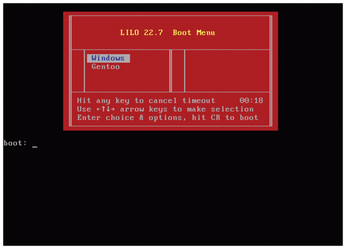
More than 20 years ago, early adopters of Linux would typically rely on the Linux Loader (LILO) boot manager to fire up their systems. LILO, which began development in 1992 with the last version released in 2015, had one major drawback: It was unable to read filesystems, meaning that it had to know the kernel's precise memory addresses. Every kernel update meant reading the blocks again before the system could boot. Despite this drawback, LILO was easy to configure and did not require filesystem support during the boot process, because it grabbed the kernel directly at the previously defined location on the hard disk (Figure 1).
At the turn of the millennium, the Grand Unified Bootloader (GRUB) gradually replaced LILO, because it offered more flexibility in terms of filesystems and installation targets. The majority of today's systems boot with the help of GRUB 2, which was first released in 2012. GRUB 2 can handle a wide variety of filesystems, plus encryption, compression, and RAID. For some time now, systems that use systemd to initialize have also been able to opt for systemd-boot [1], which emerged from the Gummiboot bootloader as an alternative.
[...]
Buy this article as PDF
(incl. VAT)
Buy Linux Magazine
Subscribe to our Linux Newsletters
Find Linux and Open Source Jobs
Subscribe to our ADMIN Newsletters
Support Our Work
Linux Magazine content is made possible with support from readers like you. Please consider contributing when you’ve found an article to be beneficial.

News
-
Bottlenecks Discovered by Meta Engineers Lead to Scalability Improvements
Thanks to a small group of engineers at Meta, the Linux kernel module kernfs has been improved, which has led to some serious gains.
-
PwnEscape Poses VM Vulnerability
A guest-to-host escape flaw in Linux KVM, named PwnEscape, might be yet another means of attacking Linux.
-
Linux Mint 27 Set for a Christmas Release
The developers behind Linux Mint have announced a Christmas release, and it looks like Santa's sack will be brimming with features.
-
Is Linus Torvalds Vibe Coding?
The creator of Linux has added AI into his process for Linux kernel development, and it's more than just for debugging.
-
openKylin 3.0 Released with Expanded AI Integration
The latest release features a pre-installed AI agent to help perform tasks.
-
DigitalOcean Ends Open Source Credits Program
In a change that has surprised many open source developers, DigitalOcean has decided to sunset its Open Source Credits Program.
-
Office 365 Available for Testing on Linux via Bottles
Linux users can now test the official Office 365, thanks to Mirko Brombin's work on Bottles.
-
Dutch Government Turns to Open Source for Digital Sovereignty
Following in the footsteps of other European countries, the Netherlands is looking to increase its sovereign digital infrastructure with open source software.
-
Linux May Soon Work on Snapdragon X2-Based PCs
If you're thinking about buying a Snapdragon X2-based desktop or laptop, Linux may soon be an option.
-
KDE for People Initiative Calls for AI Ban in Plasma
A new community of KDE wants the project to adopt a strict no-AI policy for KDE Plasma.