


Messaging off the grid with Meshtastic
Conclusion
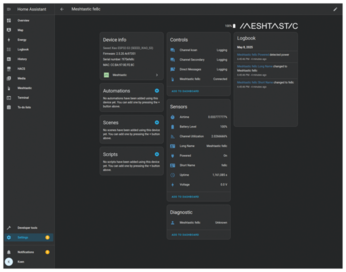
Meshtastic is a powerful technology that allows you to create a long-range wireless mesh network for off-grid communication independent of mobile network operators. The usability of this powerful mesh technology is surprisingly good, with many advanced features already built into the default firmware and accessible using the mobile app. There's also a Python command-line interface [19] to connect to a Meshtastic device from your Linux machine. This Linux integration makes all sorts of advanced integrations possible, such as the Meshtastic SAME EAS Alerter [20]. This project receives alerts from a National Weather Service radio station using an RTL-SDR [21] dongle and forwards these alerts (for example flood warnings) to the local Meshtastic network. There's also an integration for Home Assistant [22] that allows you to send and receive Meshtastic messages and track devices (Figure 18). There's also a commercial entity, Meshtastic Solutions [23]. This company develops custom solutions based on the open source Meshtastic project for its clients, for instance for monitoring cattle or building custom hardware. Now that more and more manufacturers are launching devices with Meshtastic firmware pre-installed, it is not that difficult to set up your own local mesh network.
Infos
- Meshtastic: https://meshtastic.org
- LoRa: https://www.semtech.com/lora
- GNU Radio: https://www.gnuradio.org
- gr-lora_sdr: https://github.com/tapparelj/gr-lora_sdr
- International Telecommunication Union: https://www.itu.int
- Supported devices: https://meshtastic.org/docs/hardware/devices/
- MQTT: https://mqtt.org
- Flashing the firmware: https://meshtastic.org/docs/getting-started/flashing-firmware/
- Web Flasher: https://flasher.meshtastic.org
- LoRa regions by country: https://meshtastic.org/docs/configuration/region-by-country/
- Liam Cottle's map: https://meshtastic.liamcottle.net
- uMap: https://umap.openstreetmap.de/en/
- Range records: https://meshtastic.org/docs/overview/range-tests/
- LoRa antennas: https://meshtastic.org/docs/hardware/antennas/
- NanoVNA: https://nanovna.com
- Meshtastic Site Planner: https://site.meshtastic.org
- Remote administration: https://meshtastic.org/docs/configuration/remote-admin/
- MeshSense: https://affirmatech.com/meshsense
- Python command-line interface: https://meshtastic.org/docs/software/python/cli/
- Meshtastic SAME EAS Alerter: https://github.com/RCGV1/Meshtastic-SAME-EAS-Alerter
- RTL-SDR: https://www.rtl-sdr.com
- Integration for Home Assistant: https://github.com/meshtastic/home-assistant
- Meshtastic Solutions: https://meshtastic.com
The Author

Koen Vervloesem has been writing about Linux and open source, computer security, privacy, programming, artificial intelligence, and the Internet of Things for more than 25 years. He holds Master's degrees in Computer Science Engineering and Philosophy and is teaching Linux, Python, and IoT classes. You can find more on his website at http://koen.vervloesem.eu.
Buy this article as PDF
(incl. VAT)
Buy Linux Magazine


US / Canada
UK / Australia
Subscribe to our Linux Newsletters
Find Linux and Open Source Jobs
Subscribe to our ADMIN Newsletters
Support Our Work
Linux Magazine content is made possible with support from readers like you. Please consider contributing when you’ve found an article to be beneficial.

News
-
Parrot OS Switches to KDE Plasma Desktop
Yet another distro is making the move to the KDE Plasma desktop.
-
TUXEDO Announces Gemini 17
TUXEDO Computers has released the fourth generation of its Gemini laptop with plenty of updates.
-
Two New Distros Adopt Enlightenment
MX Moksha and AV Linux 25 join ranks with Bodhi Linux and embrace the Enlightenment desktop.
-
Solus Linux 4.8 Removes Python 2
Solus Linux 4.8 has been released with the latest Linux kernel, updated desktops, and a key removal.
-
Zorin OS 18 Hits over a Million Downloads
If you doubt Linux isn't gaining popularity, you only have to look at Zorin OS's download numbers.
-
TUXEDO Computers Scraps Snapdragon X1E-Based Laptop
Due to issues with a Snapdragon CPU, TUXEDO Computers has cancelled its plans to release a laptop based on this elite hardware.
-
Debian Unleashes Debian Libre Live
Debian Libre Live keeps your machine free of proprietary software.
-
Valve Announces Pending Release of Steam Machine
Shout it to the heavens: Steam Machine, powered by Linux, is set to arrive in 2026.
-
Happy Birthday, ADMIN Magazine!
ADMIN is celebrating its 15th anniversary with issue #90.
-
Another Linux Malware Discovered
Russian hackers use Hyper-V to hide malware within Linux virtual machines.