


Making art in the terminal window
The 24-Bit True Color Mode
For those who believe no number of colors is too many, there's True Color mode: 24-bit RGB.
This mode supports over 16.7 million colors, the same as your monitor (assuming it isn't from the same era as ANSI itself).
To bring the colors to life, you can use the following syntax:
\033[38;2;<r>;<g>;<b>m<C> : Foreground
\033[48;2;<r>;<g>;<b>m<C> : Background
For example:
std::cout << "\033[38;2;255;128;0mOrange text\033[0m\n";
std::cout << "\033[48;2;0;64;128mBlue background\033[0m\n";
With all this in mind, now you can create a beautiful color picker, as shown in Figure 2. Not as sophisticated as the one you would get from a native GUI application, and still missing a mouse, but the color picker in Figure 2 still does the job if you are willing to move around with the cursor keys to browse the colors and use s and w for adjusting the luminosity.
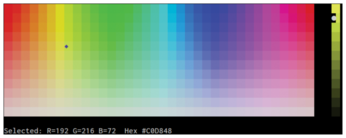
The source of this colorful beauty is to be found in colorsel.cpp, but sadly, it is too long to waste the paper of a printed journal on it. The best way to understand the application of this color picker is to take a small detour into color spaces.
Color Spaces
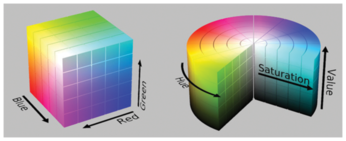
Color representation in digital systems is most commonly modeled using the RGB and HSV color spaces, each optimized for different purposes. The RGB model (Red, Green, Blue) is an additive system in which colors are generated by combining varying intensities of these three primary components. Each component typically ranges from zero to its maximum, conventionally 255 in 8-bit systems.
RGB can be visualized as a three-dimensional cube: The origin corresponds to black, the vertex at maximal intensity in all three channels corresponds to white, and the edges represent the pure primary colors. Intermediate points within the cube generate all possible colors achievable by additive mixing of the three components. While this model is directly aligned with the physical mechanisms of light emission in displays, it is not particularly intuitive for human color perception, as the perceptual differences between colors do not correspond linearly to distances within the RGB cube.
To address perceptual intuitiveness, the HSV model (Hue, Saturation, Value) is often employed. Hue is the qualitative aspect of color, representing angles along a 360-degree color wheel, where 0 is red, 120 is green, and 240 is blue. Saturation quantifies the purity or intensity of the color, ranging from zero (a neutral gray) to one (fully saturated). Value measures the brightness of the color, from complete black at zero to maximum brightness at one. This model can be visualized as a cylindrical or conical volume: Hue determines the angular coordinate, saturation the radial distance from the central axis, and value the vertical axis.
Conversion between HSV and RGB is mathematically straightforward and involves a complex mathematical formula I will skip for now.
Figure 3, which we bravely borrowed from the researchgate.net website [2] depicts the relationship between the two color spaces.
A Word on Compatibility
Not every terminal speaks fluent RGB. Most modern terminals fully support 24-bit, and some older ones only understand 256-color mode. The ancient ones spoke only green. If you're unsure, you can test with a short script, such as:
[[ "$COLORTERM" == *truecolor* || "$COLORTERM" == *24bit* ]] && echo "True Color supported" || echo "No True Color"
or just print a rainbow and see what happens (Listing 2).
Listing 2
Printing a Rainbow
awk -v w=80 'BEGIN{for(i=0;i<w;i++){r=int(128+127*cos(i*6.283/w));g=int(128+127*cos(i*6.283/w+2.094));\
  b=int(128+127*cos(i*6.283/w+4.188));printf "\033[48;2;%d;%d;%dm ",r,g,b}print "\033[0m"}'
Buy this article as PDF
(incl. VAT)
Buy Linux Magazine
Subscribe to our Linux Newsletters
Find Linux and Open Source Jobs
Subscribe to our ADMIN Newsletters
Support Our Work
Linux Magazine content is made possible with support from readers like you. Please consider contributing when you’ve found an article to be beneficial.

News
-
AI Helped Develop a Linux Exploit
A use-after-free race exploit was discovered and exploited on CentOS Stream 9.
-
Yet Another Linux Kernel Vulnerability Discovered
Affecting millions of systems, a kernel flaw discovered by Qualys could allow users to gain root privileges.
-
Ubuntu 26.10 to Include Ubuntu Certified Hardware Check
If you've ever wondered if your laptop or PC is officially certified to run Ubuntu, that curiosity will soon be met.
-
Substantial Update to IPFire Now Available
The lastest version of IPFire features a fundamental change to how the system handles DNS.
-
Gnome Working on Test Center App to Make Testing Easier
It's now possible to test experimental features on the Gnome desktop without worrying that you'll break things.
-
New Vulnerability Discovered in Linux Kernel
Hiding out for nearly 15 years, the Ghostlock vulnerability allows a standard logged-in user to gain root privileges.
-
New Linux Flaw Lets Attackers Escape VMs
A 16-year-old vulnerability allows an attacker to escape a virtual machine, gain access to the host, and execute malicious code.
-
Hannah Montana Linux Is Back!
Developer Noah Cagle decided the world needed the once obscure but beloved Linux distribution and gave it a decidedly pink refresh.
-
System76 Refreshes the Lemur Laptop
If you're looking for a laptop with tons of power and battery, look no further than the latest iteration of the System76 Lemur Pro.
-
More than 43 Million Lines of Code in Linux Kernel 7.2
Using the cloc utility, Michael Larabel of Phoronix discovered that Linux kernel 7.2 has over 43 million lines of code.